Monday, October 30, 2006

Scrubs Season Four: Still Loopy After All These Years


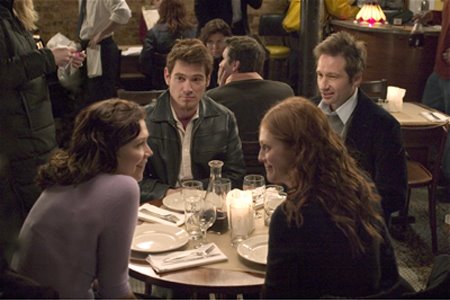
"... even during its slumps, Scrubs is still one of the more charming and earnest shows on television and it’s hard to fault a show this genuine and eager to please."

Read my entire review at TheCinemaSource.com

Friday, October 27, 2006

Babel: Heavy Duty Trauma


"It’s not the movie stars (Pitt, Blanchett, Bernal) who demand the most attention in these continent-spanning stories. Rather it’s the fearless performance by Kikuchi and the heart-wrenching sympathy evoked by Barraza that are the most memorable and emotionally devastating."

Read my entire review at TheCinemaSource.com

Friday, October 13, 2006

Man of the Year: Save Your Vote


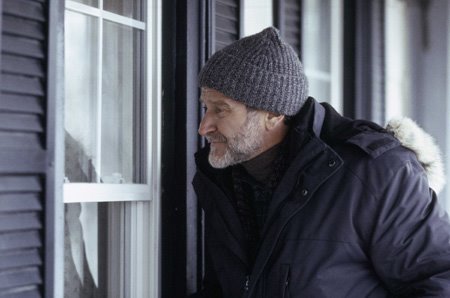
"...A political comedy of this nature works best as either an all-out farce or a sobering allegory, not the limp shape of a film that Man of the Year adopts. The film works only as campaign material for Williams’ candidacy as a successful talk show host."

Read my entire review at TheCinemaSource.com

Wednesday, October 11, 2006

Monday, May 08, 2006

Wannabe Intellectuals and the Women Who Love Them

Gender Politics in Dogville and Pierrot Le Fou

Laura Mulvey’s seminal article, “Visual Pleasure and Narrative Cinema,” proposes a number of ideas about spectator identification. The revolutionary theories she presented have been refuted and reinterpreted extensively over the past thirty years. Mulvey’s writing pertains predominantly to mainstream narrative features. However, her text is a very useful one and many of her ideas can be applied to films that skewer the fundamentals of traditional cinema. Even two directors with approaches to film form as radical as Jean-Luc Godard and Lars Von Trier have produced works that are applicable to Mulvey’s teachings. This analysis will compare representations of Mulvey’s arguments in a film by each respective director. The two films being compared are Godard’s Pierrot le Fou (1965) and Dogville (2003). The extreme difference in production time period serves as a symbol for how enduring an argument Mulvey makes.

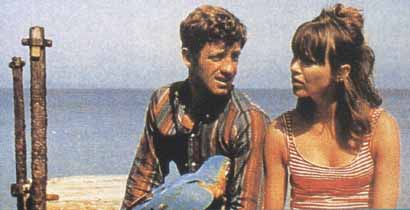
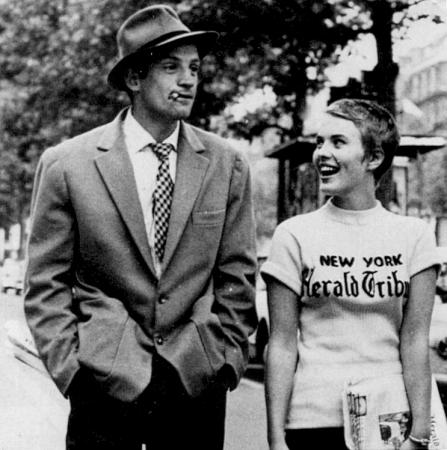
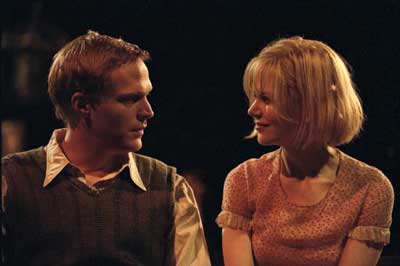
Ostensibly, the films make an odd pair for this type of analysis. The starting point for comparing the two films lies in the similarities of their lead male characters. Both Ferdinand (Jean-Paul Belmondo) in Pierrot and Tom (Paul Bettany) in Dogville are pseudo-intellectuals who bury themselves in ideals, analytical dissection and philosophical musings. If forced to label them, one could say Ferdinand is characterized by Sartre’s Existentialism in the sense of denying the universe has any meaning or purpose, therefore the individual must take power into own hands. On the other hand, Tom is Derrida’s Deconstruction, dealing with the ways that meaning is constructed and understood by its readers. Their pursuit of academic enlightenment and intellectualism comes at the cost of not being able to identify with their female counterparts. The male protagonists ignore the emotional desires of their lovers and because of this inability to relate to women, they eventually meet their demise at the hands of the woman (Tom’s case) or the woman’s influence (Ferdinand’s case).

One of Mulvey’s major themes is the casting of the male as active and the female as passive - constructing a male gaze that projects its fantasy on to the female figure. “Presence of woman is an indispensable element of spectacle in normal narrative film, yet her visual presence tends to work against the development of a story line, to freeze the flow of action in moment’s of erotic contemplation” (Mulvey, 840). Pierrot le Fou reverses this theory in a variety of ways. The female protagonist, Marianne (Anna Karina), is presented alongside Ferdinand as a co-narrator in a few important sequences. Voice-over narrations provided by the two characters are spliced together to give equal time to the characters as they comment on the plot’s events seen in the sequence following their first murder and subsequent getaway. Marianne’s repeated, “Leave in a hurry,” line is delivered with urgency and expediency. Marianne is also positioned as the sole proponent for propelling the plot forward during the middle section of the film. After making it to the island, Ferdinand is content to sit around and contemplate life but Marianne is more interested in living life, complaining about there being nothing to do. This representation inverts Mulvey’s theory, presenting us with an active female and passive male. It is Marianne’s restlessness that directs the film’s plot back onto the path of gun-running and gangsters. In a scene that can be looked at in comparison with Mulvey’s characterization of women in films existing as showgirls who pause the narrative through song and dance, Marianne appears singing and dancing on the beach while meeting with the gun-runner and orchestrating the plan to set up Ferdinand. Marianne simultaneously progresses the plot and appears as a song-and-dance spectacle.

One of Mulvey’s issues that bears greater importance in Dogville than in Pierrot is the practice of scopophilia. The term refers to the primary act of looking itself as a “source of pleasure… taking other people as objects, subjecting them to a controlling and curious gaze” (Mulvey, 839). Dogville is intrinsically linked to this practice by its approach to filmic style. Trier considers the work “a fusion film” (Bjorkman 241). He achieves this product by directly incorporating elements of theatre and literature into a cinematic discourse. He instills the medium of literature through the presence of a third-person narrator voiced by John Hurt. The narrator is omniscient and does not appear as a character in the diegesis, a form that Gérard Genette dubs heterodiegetic. The voice-over is excessive and blatantly invokes the literary format through its constant description of events and internal character reflection.

It is in the incorporation of theater that Dogville attains its most scopophilic aspect. In an approach that calls upon Thornton Wilder’s Our Town and the theater of Brecht, Trier shoots the film on a single sound stage with minimal set design. There is the occasional prop (a telephone, a baby carriage, beds, etc.) but chalk outlines delineate houses and walls and characters mime opening and closing non-existent doors. This creates a paradoxically open- and closed-environment for the characters to inhabit. In wide shots, the viewer is given visual access to the private lives of the characters via the absence of physical walls but the characters’ vision is constricted by the diegetic presence of walls. The scene in which this dichotomy is best articulated is Grace’s rape at the hands of Chuck (Stellan Skarsgard). Chuck decides not to inform Grace that the police official is coming and proceeds to blackmail Grace into having sex with him in order to keep him from alerting the police of her whereabouts. In a long shot, the viewer sees the townspeople talking to the police in the middle of the street completely oblivious of Chuck and Grace in the background, despite them being in plain sight for the viewer. To tackle this issue we must address Mulvey’s theory about the three different looks associated with the cinema:
The camera as it records the pro-filmic event, that of the audience as it watches the final product, and that of the characters at each other within the screen illusion. The conventions of narrative film deny the first two and subordinate them to the third, the conscious aim being always to eliminate intrusive camera presence and prevent a distancing awareness on the audience. (Mulvey, 847)

The rape scene in Dogville perfectly illustrates Mulvey’s distinction between the look of the audience and the look of the characters. However, the scene fundamentally disproves her statement that narrative film subordinates the look of the audience to the look of the characters because in this example the reverse is true. The audience is privileged over the characters in their unobstructed visual access to the town. Ultimately, this look is subordinate to the look of the camera because the camera decides where and when to look during the filming of the event. The viewer cannot choose to suddenly look at the coal mine or the meeting hall at any given moment because the camera dictates what is present on the visual plane. What the audience can do is look anywhere they like within the frame, something the characters cannot do due to physical obstructions.

The importance of characters looking is reprised in the film’s violent conclusion. After initially trying to defend the town, Grace gives the ultimate order for her father’s gangsters to destroy the town and murder all the townspeople. Seated in the backseat of her father’s car, she is asked if they should open the curtains and look out while the town is sacked. Grace responds, “I think we should open them, it’s appropriate.” She observes the town’s demolition in tearful contemplation, occasionally looking away but always returning to the view of the violence. Grace exhibits a certain kind of pleasure in this sequence as she exacts revenge on the townspeople for her constant abuse. She appears particularly vindictive by ordering that the seven children be murdered in front of their mother while she watches. By forcing the mother to witness her children’s death, she is administering and controlling the gaze upon others. In this sequence, Grace asserts herself as the active male, repositioning her role from that of the one looked at by the townspeople. Mulvey says that in mainstream cinema, the man is positioned as in control of the power “by structuring the film around a main controlling figure with whom the spectator can identify” (Mulvey, 842). For almost the entire narrative, Grace has been the subject of a to-be-looked-at-ness by the townspeople. In this final sequence, she overthrows the hierarchy and assumes the position of the main controlling figure. Even though she achieves this authority through the arrival of her father, she is the one issuing the orders and determining the peoples’ fates. Grace even graduates from looking and proves her physical prowess by shooting Tom in the back of the head. The conclusion reaffirms Grace’s autonomy in the narrative, casting her presence as disruptive to the town of Dogville. While the townspeople’s behavior is held responsible for their fates, it is Grace’s role in the narrative that spurs them to behave in the way that they do.

Given her integrality to the plot’s events and her ultimate act of vengeance, Grace can be positioned alongside Marianne as the active female. However, there are also elements of her treatment that adhere to Mulvey’s hypotheses about the male gaze. At one point Liz (Chloë Sevigny) thanks Grace for redirecting the male characters’ looks to her, implying she was tired of being viewed as a sexual object and glad to rid herself of that kind of attention. Once the townspeople begin to blackmail Grace into working overtime, the men also begin to take advantage of her sexually. The narrator informs us that almost all the men were having their turn with her and it was common knowledge throughout the town as the children would ring the town bell to commemorate each occasion. The narrator says the events could not really be considered sexual acts and they were more a form of embarrassment, akin to the way a hillbilly would abuse a cow. Mulvey says that scopophilia gets complicated when forced to consider the act of voyeurism, which “has associations with sadism: pleasure lies in ascertaining guilt… asserting control and subjecting the guilty person through punishment or forgiveness” (Mulvey, 844). Sadism aptly describes the way in which Grace is treated after the townspeople find out she is wanted by the authorities in connection with some bank robberies. Grace mirrors their sadistic behavior in her explosive act of revenge.

Tom is one of the few male characters who does not take advantage of Grace’s body. While he has lustful intentions, he does not force her to have sex with him. Instead he takes advantage of her by approaching her from an academic standpoint disguised as an emotional attachment. Tom attempts to position himself as a figure of influence upon the town by holding moral sermons of enlightenment that he refers to as “illustrations.” He takes pride in being able to analyze the townspeople and gleefully informs Grace about all their shortcomings and character flaws. On the fourth of July he pulls Grace aside and confesses he cannot get a read on her. Grace goads him into saying the feelings mean that he is in love with her and tells him she thinks she is in love with him too. Tom responds to this declaration of love with, “Very interesting. Interesting in a psychological…” before trailing off. This instance distinguishes Grace’s feelings as emotional and Tom’s as scientific. Tom cannot reciprocate Grace’s feelings of intimacy and love, becoming preoccupied with his carnal desires. He also disrespects her intelligence after he lies about stealing money from the medicine closet by telling her “I’m here to do the thinking for you.” Tom not only acts as her brain but also as her voice, representing her at the town meetings which she is rarely allowed to attend.

The pivotal scene for Tom’s character is his decision to call the gangsters. After defending Grace at the meeting, he returns to Grace’s house and expects her to have sex with him. As Tom gets on top of her and begins to thrust, the camera zooms out, suggesting that Grace has finally agreed. After a few seconds Grace contests and the camera zooms back in, teasing the viewer’s presupposed notions about camera movement. The narrator informs the viewer that Tom is angry his feelings of temptation have been found out by God and that Grace had become a threat to his career as a writer. “Tom allows sincerity and ideals in life without getting sentimental about it.” Here Tom chooses academics over emotion and uses his experience with Grace as inspiration for the first chapter of his novel. In this way, Tom enacts a type of his own abuse, using her suffering and torture to jumpstart his literary career. Tom’s mistreatment of Grace can be tied in with Mulvey’s psychoanalytic association of the female figure with the threat of castration:
Ultimately, the meaning of woman is sexual difference, the absence of the penis as visually ascertainable… Thus the woman as icon, displayed for the gaze and enjoyment of men, the active controllers of the look, always threatens to evoke the anxiety it originally signified. (844).
Mulvey says the male unconscious has two options for dealing with this, either demystifying her image through rigorous deconstruction, as Tom does, or by fetishizing - turning her into a simple sex object, as the other men in town do.
In Pierrot le Fou, Ferdinand puts a similar preference for writing over emotional attachment to people. Douglas Morrey posits that there is a tendency to “associate Marianne with nature, and with a concrete reality, while Ferdinand is associated with language and abstraction (he spends much of the film reading and writing)” (Morey, 27). It is also important to note how much of the film he spends quoting philosophical thinkers or behaving like characters he has seen in a movie: his driving the car into the ocean is a good example of his penchant for cinematic spectacle. Once on the island all he wants to do is write, telling the camera directly that he wants to write about life itself and create something worthwhile. When Marianne brings out a record, he yells “Literature before music!” Marianne later tells the camera that she wanted to buy a record but all their money was spent on books, which she doesn’t care about. Nor does she care about records or money, she just wants to live. Ferdinand also belittles her when she does not catch a reference he makes to the film Pepé le Moko. Ultimately Marianne double crosses Ferdinand and runs off with the gun-runner she had referred to as her “brother.” It is unclear at what point Marianne decides to double cross Ferdinand. It is possible she was planning it from the beginning and there is also the generic constraint of having a femme fatale in a film noir. But if we look at it sequentially, it appears as a result of his ignoring her needs and desires. She repeatedly tells him she loves him but Ferdinand seems too much in love with himself to reciprocate. A scene early in the film articulates their respective desires. Marianne catches Ferdinand looking at himself in the rear view mirror. When questioned, he says he sees “a man about to drive off a cliff.” Marianne looks at herself in the mirror and says she sees “a woman in love with a man about to drive off a cliff.” Ferdinand admits his self-centeredness and inability to relate to her when he tells the camera, “When Marianne says ‘It’s a nice day,’ what is she thinking? All I have is the appearance of her saying ‘It’s a nice day.”

Both Ferdinand and Tom put their writing before their women and both ultimately pay the price for it. Their demises are slightly different. Tom meets his death at the hands of Grace while Ferdinand kills himself after shooting Marianne. In Ferdinand’s case he gets revenge on Marianne for being double crossed but he loses his mind in the process. Both endings signify their failure to become writers. Even when given the opportunity for repentance, Tom hides behind academics, telling Grace that her experience in Dogville has been an illustration and that a lot can be learned from it. Following this, Grace gives the order to destroy the town. Just before Grace shoots him, he makes one last bid for literary fame, asking if he can use this as inspiration for his writing. Tom’s clear disillusionment over the situation reiterates his incompetence at personal relations. Conversely, Ferdinand regards Marianne as a distraction that keeps him from obtaining literary enlightenment. However, this proves not to be the case as when he has freed himself from her in the end, he blows himself up with dynamite, saying he is tired anyway. Both Dogville and Pierrot le Fou ultimately position their female protagonists as the dominant figures of control over their weaker male counterparts.

Refererences
Bjorkman, Stig. Trier on Von Trier. London: Faber and Faber, 2003.
Morrey, Douglas. Jean-Luc Godard. Manchester and New York: Manchester University Press, 2005.
Mulvey, Laura. “Visual Pleasure and Narrative Cinema.” Film Theory and Criticism. Ed.
Leo Braudy and Marshall Cohen. Oxford: Oxford University Press, 2004, 837- 848.

Thursday, April 27, 2006

Lucky Number Slevin: Hedge Your Bets


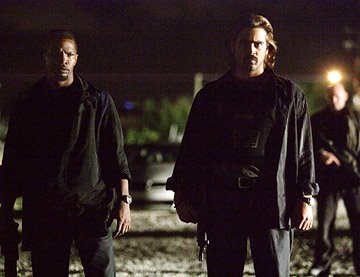
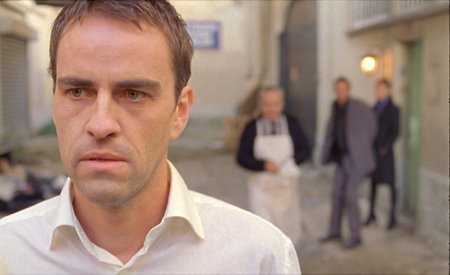
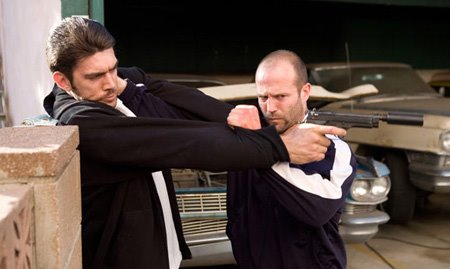
Lucky Number Slevin marks the reunion between Wicker Park collaborators Josh Hartnett and director Paul McGuigan. Their first effort was a mildly diverting, watered-down remake of a French psychological thriller, L’Appartement. Their second work together is a considerable step-up in prestige.The first element of notice is the massive upgrade in star talent. Gone is Matthew Lillard, replaced by the likes of Morgan Freeman, Ben Kingsley, Lucy Liu, Stanley Tucci and Bruce Willis. The production scale is higher, the violence is more gruesome and the plot is more intricately woven. Unfortunately all these enrichments in talent and resources do not correlate to an increase in quality.

The film’s complex plotting revolves around a case of mistaken identity within the enacting of a Kansas City Shuffle. Bruce Willis plays Mr. Goodkat, a widely-revered contract killer who explains early on that a Kansas City Shuffle refers to a coup in which you make them look left while they should be looking right. So immediately we know the film is going to have a surprise ending. Given the opening credits in which the identity of a killer is carefully disguised, it’s not difficult to guess at what that’s going to be. Josh Hartnett plays Slevin Kelevra, the misidentified man stuck in the midst of a major crime war. Through Goodkat’s careful administration, he finds himself at the mercy of both The Boss (Morgan Freeman) and The Rabbi (Ben Kingsley). The two are in charge of New York City’s most intimidating crime syndicates. There was a time that they worked together but now they inhabit dueling perches in their offices; neither one ever leaving their building for fear of the other’s wrath.

There is also Lucy Liu as Lindsey, the next door neighbor to Nick Fisher, the man Slevin has been mistaken for. Her main purposes in the movie are to be attracted to Slevin and to recap events in a rapid-fire delivery for comedic effect – granted she is good at both. The always entertaining Stanley Tucci is also on hand as a detective trying to monitor the actions between the gangsters. He is solid as usual but his character is the same prickly, self-involved narcissist that he so often plays. Bruce Willis suffers from a similar fate, as he is resting on the soft-spoken, steely-eyed presence he perfected in the 90s. After a string of interesting roles, this is his blandest role in years. Josh Hartnett is serviceable in the lead role but orchestrates his own downfall through his pitch-perfect performance in the romantic scenes with Lucy Liu as opposed to his inconsistency as the sarcastic wise-ass when interacting with the gangsters. Morgan Freeman and Ben Kingsley give performances worthy of their esteemed reputations – there is an absolutely sublime scene where the two talk face-to-face and are given the opportunity to flesh out their characters more than anyone else in the film.

To say that McGuigan directs with visual flair would be to complement his distracting over direction. While there is one scene that is inventive and expedient in the way it constructs a three-way conversation that manipulates past and present, most of the style is just distracting. The filmmakers feel so proud of their clearly CGI-enhanced-shot panning from The Boss’ window to The Rabbi’s window that they not only plaster it in every trailer and TV spot, they have the audacity to play it twice in the movie. There is also a maddening scene in which the camera continually moves back and forth behind a wall during a conversation between Lindsey and Slevin. McGuigan does manage to incorporate two nice visual motifs: numbers and Slevin getting punched, the latter being more the most satisfying of the two.

For those who are fans of the genre, there is a lot to enjoy in its adherence to the post-Pulp Fiction crime film. There is the obligatory monologue about a comic book character (delivered by poor Morgan Freeman), a Hitchcock reference, excessively bloody kill shots, stylish camera work and even a peppy song over the end credits. However, non-fans will tire from the unlikable characters and the script’s desires to continually reverse the viewers’ expectations at the expense of character consistency. Most offensive is the way the film takes pride in being unpleasant and sadistic, only to cop out with a sappy conclusion at an airport, almost identical to the ending that plagued Wicker Park.

Sunday, April 09, 2006

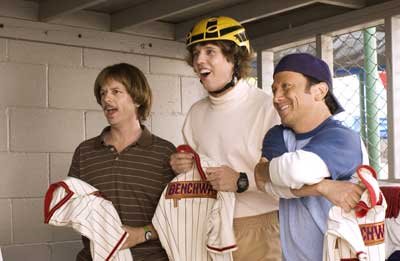
The Benchwarmers: Bring on the B-Team


There was a time during the mid to late 90s when motion picture comedies were dominated by SNL alumni. It seemed as if every box office success either starred Adam Sandler or someone closely related to him. After a couple of hits, these films became readily identifiable by the helpful Happy Madison production company logo being branded onto these seemingly identical movies about goofy stunted adolescents who often suffer from uncontrollable rage and limited intelligence. They repeatedly find themselves in gimmicky plots that always manage to culminate in their coupling with a tall, skinny, blond woman with mediocre acting skills. To further decreasen distinctiveness, the titles were conveniently named after their lead character (Happy Gilmore) or their lead character's gimmick (The Animal) or even both (Deuce Bigalow: Male Gigolo).

As time has passed, their success has weakened. The ringleader, Adam Sandler, has managed to survive with box office smashes like 50 First Dates and The Longest Yard while garnering respect by acting in projects that still resemble his traditioal fare but are given prestige due to their director's established talents as is the case with Punch Drunk Love and Spanglish. Aside from Sandler, the rest of the troupe have sunk into mediocrity with embarrassing vanity projects. The Benchwarmers marks the materialization of this degradation for Rob Schneider and David Spade.

Now that the comedy scene is dominated by what has come to be referred to as the "frat pack" (Vince Vaughn, Will Ferrell, Ben Stiller, etc.), the Happy Madison troupe has run into trouble headlining films on their own. While a Schneider or Spade vehicle can no longer be relied on to make more than $30 million theatrically (not the end of the world since their films generally carry $15-20 million production budgets and some such as Joe Dirt make a killing on DVD), maybe if they pool their talents then can eek something up to the $50 million mark. And so, The Benchwarmers, a film about three geeky adults who are given the chance to play against the best (and meanest) little league teams to promote tolerance ad affection for the less talented kids in the baseball world, the film becomes a metaphor for the three lead actors' careers. Late in the film, a member of the bully team remarks "they're congratulating him for striking out! The coach isn't yelling or anything!" We assume the director isn't doing much yelling at the actors either, instead letting these three has-beens and second rate movie stars show the bankable stars that the losers can still have a little fun too.

David Spade has shown himself to be humble and resigned about his celebrity status as of late: going on record that the only reason he is still getting work in movies is because of Adam Sandler's wealth and generosity. Schneider has been less admirable, garnering a reputation as a pompous egomaniac but in spite of this he still plays the nice, sensible guy with irresistibly hammy relish. Admittedly the ignominy of has-been is a little harsh on Napoleon Dynamite star, Jon Heder, but his decision to join this crew by-passes his star descent and goes straight to the bargain bin. Problematically, Heder is attached to co-star with Will Ferrell in the figure skating comedy, Blades of Glory. But will this mark Heder's trope ascension or Ferrell's demotion?

As for The Benchwarmers as a movie, there isn't much to say. There are a few laughs here and there but never anything consistent. Jon Lovitz is at the top of his game as always and Schneider, Spade and Heder add at least one or two bright moments each but most scenes are undercut by unjustified vomiting or midget exploitation. The soundtrack mimics the hodgepodge approach to comedy by bombarding us with eclectic pop music with complete disregard for context or synthesizing with the visuals. Recycled opening chords of Dire Straits songs or instrumental refrains from a New Found Glory hit take the place of a musical score. It's as if the record company shoved a bunch of songs on the music supervisor's desk, who preceeded to throw them all in and assume one or two would stick. In their defense, the occasional song works. However one of the successes is the indestructible "Jerk it Out" by The Caesars which has made its way from Ipod commercial to Yours Mine & Ours to The Pink Panther trailers, so no points for originality there. Overall it's pretty poor craftsmanship but mercifully the cast and crew acknowledge this throughout, most beautifully articulated in the final end credit outtake where Jon Lovitz asks "Has this been a big waste of time?" to which Schneider replies, "Yeah pretty much."

Saturday, March 25, 2006

Fiction and Documentary Self-Reflexivity in Breathless and The Idiots


By the mid-1950s, interest in French film was on a steady decline. The major production forces had become preoccupied with “generic historical reconstructions and uninspired literary adaptations” that left the public restless and gave little room for creative pioneering (Neupart, xvii). Fortunately, the end of the decade saw the beginning of a rejuvenation period for French cinema known as the Nuevelle Vague or the French New Wave. The movement was comprised of a series of young filmmakers who were making low-budget films that focused on the youthful sentiments of the time. The filmmakers “followed the lead of the neo-realists, shooting primarily on location, using new or lesser-known actors and small production crews” (Neupart, xvii). While the classification of French New Wave has come to be a bit of a slippery term in reference to exactly what it classifies, Richard Neupart defines the period as lasting from 1958-1964 in his A History of the French New Wave.
Many of the filmmakers (but not all) who headlined this movement began as critics for the extremely influential French publication, Cahiers du cinema. One such critic-turned-filmmaker is Jean-Luc Godard, a name that has become synonymous with the French New Wave. While Godard has long outlived the French New Wave and continues to make films today, his later work became fiercely political and operates in a style somewhat removed from his early work. His films during the French New Wave are characterized as more playful and more reverent of film history and pop culture than his more recent work. His debut feature, À Bout de Souffle or Breathless (1959) is regarded as particularly laudatory of the American cinema and specifically the film noir genre.
One quality that has remained constant throughout his work is his penchant for self-reflexivity. The notion of self-reflexivity, as it is seen in Godard’s work, owes a great deal to the German dramatist of the early 20th century, Bertolt Brecht, and his notion of the “epic theater” or “theater of alienation.” Brecht “called for a fragmented, distantiated, ‘theater of interruptions’ which fostered critical distance” (Stam, 224). The aim was to constantly remind the audience that they were watching a constructed work of art and not a real life occurrence. One of the prominent ways of achieving this was having the actors break the fourth wall on stage and interact directly with the audience, a technique that came to be referred to as direct address.
Transferring this practice to the cinema directly opposed the early practices in film composition that strived to mimic reality, sometimes referred to as illusionism: “the belief that we are in the presence of real events and real characters” (Gaut, 90). Godard achieved a Brechtian distantiation in film through a number of elements; his most innovative feature may well have been his approach to editing. This can be seen perfectly in Breathless. While classical Hollywood cinema followed a highly structuralized editing system of establishing shots and shot/reverse shot sequences and André Bazin continually touted the merits of depth-of-focus and long takes to show continuous motion, Godard looked to instill a fractured nature in his editing process. By using a technique known as the jump-cut (two shots of the same subject cut together with little change in camera distance and angle), he jarred audiences by rupturing the flow of temporal and spatial continuity that had previously been the norm. One of the most notable instances of this appears during the first time Patricia (Jean Seberg) gets in Michel’s (Jean-Paul Belmondo) car. While the two drive around Paris, the shot is held on a relatively static Patricia’s head in the passenger seat but the location radically changes by way of jump-cuts. In this sequence the editing violently calls attention to itself, reminding the viewer that the film is put together by an authorial force. Given that the figure of Patricia is not radically displaced by the cuts, it conveys the impression of a long take that has been abbreviated, as if the camera has decided to cut ahead and skip certain parts of their drive in order to create its own plot.
The scene in which the camera is most anthropomorphized occurs at the beginning of the film when Michel steals the car and the camera seemingly jumps into the passenger seat as if it is along for the ride with Michel. From the amount of hood that is visible we can see that the camera is situated in the passenger seat and the shot takes on a POV connotation through its shaky handheld qualities. In the same scene, the camera definitively asserts itself as an active character when Michel turns and talks directly to it without being spurred by any force other than his internal need to comment on his situation.
Of course, Brechtian techniques and self-reflexivity in film is not a trait exclusive to the French New Wave. Another group that utilizes some of the characteristics set forth by Brecht is the Dogma 95 movement spearheaded by Thomas Vinterberg and Lars von Trier. While the movement is not identical to the French New Wave (for starters one of the goals is to avoid valorizing the auteur), it does share the same low-budget attitude in their “practice of rule-following to articulate and circulate a stripped-down and hence widely affordable concept of filmmaking” (Hjort, 31). The French New Wave shot on location and in the streets as a way to avoid studio costs. Similarly, the first entry in the Dogma 95 ‘vows of chastity’ is “Shooting must be done on location. Props and sets must not be brought in” (Hjort, 199). In addition, Dogma was eager to get away from the film of illusion approach which they believed to be “decadent and bourgeois, its supreme task being to fool the audience” (Hjort, 89). One way they combated this was by utilizing a documentary approach to filmmaking. In a sense, this brought a quality of Bazanian realism in that the camera could run for long periods of time while the actors improvised. Even though the Dogma 95 films do not present the sense of realism that we would expect based on classical Hollywood cinema foundations, it does create a sense of documentary realism.
The second film to bear the Dogma 95 seal of approval, Lars Von Trier’s The Idiots (1998) playfully straddles the line between documentary and fictional narrative. Since it is in fact a fiction film, the documentary techniques serve as self-reflexive because they draw attention to the filmmaking process and cause the viewer to question what form of cinema they are actually watching. In certain shots we can briefly make out the filming equipment, most notably in the factory scene when the boom microphone is clearly in the frame as the handheld camera jerks back. There is also the element of having the characters perform direct address while they answer questions posed by an off-screen interviewer during confessional scenes scattered throughout the film. Just like Godard physically inserted himself into the film Breathless, Von Trier inscribes himself into the Idiots by supplying the voice of the off-screen interviewer. Godard performed the same function in his 1967 film Two or Three Things I Know About Her, although in that case he alternated between interviewing the actual actress and the character whereas the interviewees in The Idiots stay in character throughout.
Returning to Godard and by way of him, Breathless, another element of self-reflexivity that must be touched upon is the presence of the cinema as a physical site in the diegesis. Author Douglas Morey makes note of this in his book Jean-Luc Godard: “Actual Parisian cinemas feature a number of times in the film as hiding places and lieux de passage and a young woman is seen selling copies of cahiers du cinema on the street” (Morey, 8). It is important here to make the slight distinction between the occasions in which Breathless acknowledges the medium of film and when it acknowledges that the viewer is actively watching a film because of the construction. While the roaming camera, editing and direct address are self-reflexive in the traditional Brechtian sense, the references to the filmic medium often become self-reflexive as well. While it may not be empirically self-reflexive for Michel and Patricia to choose to hide in a cinema while the police are pursuing them or for Michel to mention he worked as an assistant on a film production in Rome, there are times when the medium is acknowledged in interetextual ways.
One such example occurs near the beginning when Michel is trying to round up money from his friends. After having no luck he tells his friend that “Bob the gambler would have helped me out,” to which he is reminded, “Bob is in jail.” This is a direct reference to the 1955 French film Bob le flambeur, a work that is often considered a precursor to the French New Wave. If not indicative of the movement as a whole, it is certainly a great influence on Breathless as it is shot in the similar black-and-white film noir style. The verbal cue is a tribute to Bob le flambeur and to accentuate it visually, the film’s director, Jean-Pierre Melville appears on-screen as Parvulesco. Another example of a director acting in the film occurs when Godard himself appears as a man on the street that recognizes Michel from the newspaper articles. The scene happens just after the lengthy hotel sequence and it is as if we see the director physically reintroducing the conflict after such a long reprieve for the characters.
One scene that blends the role of cinema within the diegesis and the acknowledgement that the viewer is watching a film is when Michel stops outside the theater and regards a photograph of Humphrey Bogart. Morey points out that on several occasions, Bogart’s “mannerism of wiping his thumb across his lips is appropriated by Michel” (Morey, 9). This motif is brought to a crescendo outside the movie theater. The diegetic sound is muted and there is a close-up on the still image of Bogart which is followed by a close-up of Michel in a shot/reverse shot pattern that evokes the standard format of conversation scenes in classical Hollywood cinema. On the cut back to Bogart’s photograph, Michel’s smoke blows into Bogart’s face, emphasizing the spatial proximity of the character to the image. Simultaneously, this scene acknowledges Michel’s desire to mimic his Bogart within the diegesis and the required knowledge of filmic discourse to notice that standard film practices are being manipulated to create the illusion of a conversation between the man and the photograph.
In Breathless and The Idiots we have two examples of early films from two very radical movements of filmmaking. Both are aimed to deviate drastically from the mainstream and as we have seen, one of their main ways of accomplishing this is self-reflexivity. Be it the acknowledgement of fictional filmmaking in Breathless or the acknowledgment of documentary filmmaking in The Idiots, the construction of the medium takes front and center and the films’ perceptions are dramatically changed. The passive viewer of the illusion film has morphed into the active viewer of the self-reflexive film, a viewer who must have a vast knowledge of cultural capital and the filmmaking process in order to appreciate the films on the level that they are designed.

References
Gaut, Berys. “Naked Film: Dogma and Its Limits.” Purity and Provocation: Dogma 95.
Eds. Hjort, Mette, and Scott MacKenzie. London: BFI, 2003, 89-101.
Hjort, Mette. “Dogma 95: A Small Nation’s Response to Globalization.” Purity and
Provocation: Dogma 95. Eds. Hjort, Mette, and Scott MacKenzie. London: BFI,
2003, 31-47.
Morrey, Douglas. Jean-Luc Godard. Manchester and New York: Manchester University
Press, 2005.
Neupart, Richard. A History of the French New Wave. Madison: The University of
Wisconsin Press, 2002.
Stam, Robert, and Toby Miller. Film Theory: An Anthology. Malden, Massachusetts:
Blackwell Publishers, 2000.

Wednesday, January 25, 2006

Top 10 of 2005

10. Walk the Line

9. Brokeback Mountain
8. Walk on Water
7. Junebug
6. Oldboy
5. The Weather Man
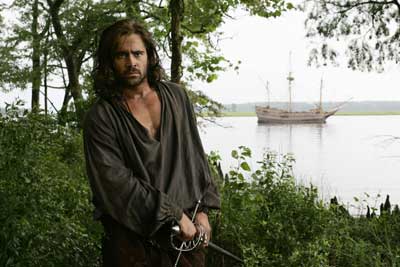
4. The New World
3. Grizzly Man
2. Pride & Prejudice
1. King Kong

Tuesday, January 17, 2006

Another Hit Man with a Heart Strikes Gold


In The Matador, Pierce Brosnan plays Julian Noble, a professional assassin dealing with the mental turmoil that comes with a life of killing. While on a job in Mexico he meets Danny Wright (Greg Kinnear), a pleasant and unassuming business man dealing with the prospect of upcoming economic and marital crisis. The two meet over some drinks and forge an unlikely friendship based on mutual interest in the other’s very different lifestyle. The film legitimizes its gimmicky plot by creating two very real characters who deal with real emotional problems. Death is given great credence and professional killing is not just an artifice but a central theme and ongoing motif. Some of the dialogue is silly and there are moments of fantasy and whimsy but the film never becomes whacky. The characters ground the film with sympathy through the emotional weight of their confessions. The script is brought to life by two actors who take their roles seriously and know how to deliver comedy without it feeling contrived. Brosnan impressively excises traces of James Bond despite playing a character not very far removed occupationally. Greg Kinnear seems to be one of the busiest actors around today turning in supporting roles in a number of diverse projects over the past few years without ever suffering from overexposure.

The dark nature of the film’s themes is counterbalanced by the colorful mise-en-scene that revels in bright backgrounds and sunny exteriors. The effective combination wards off gloom and over-sentimentality creating a consistently fun and engaging experience. This synthesis is similarly expressed in the music choices. The source music is primarily made up of peppy-sounding classic rock tracks that slyly feature meaningful lyrics accentuating the film’s mood. Examples include The Jam’s “A Town Called Malice” and Tom Jones’ “It’s Not Unusual.” Asia’s “Heat of the Moment” is a bit of a stretch but by the time it appears in the movie, the inclusion of the upbeat crowd-pleasing 80s relic is irresistible. The original score is also very successful at leveling the film’s mood, giving just the right amount of sincerity and somberness to the heavier scenes. Composer Rolfe Kent has established himself as one of the best in the business when it comes to comedic scores with his recent work in the offbeat Sideways and the more traditional Wedding Crashers. Special attention should also be given to the music editor who morphs a mildly annoying Killers song into a poignant ode to friendship in time of need, making it the perfect choice for the story’s closing song.

Wednesday, December 28, 2005

A Creature Feature of Colossal Importance


Despite having state of the art special effects, King Kong is a real throwback to early cinema. It emphasizes what going to the movies in the 30s was all about, the spectacle of it, the ability to see things you could not see anywhere else. While the interest seems to be waning, this is still what going to the movies is about in the present. In a time when we're seeing this drastic shift toward home video instead of going to the movie theater, it is very important for a film of this scale to be released, something that Spielberg also displayed in the less successfully realized War of the Worlds. The two disaster films differ in that Kong is a perfectly executed movie on all fronts: the characters, casting choices, visual effects, music score, a beating heart and even a suitably somber conclusion.

A good portion of the film’s first hour is dedicated to fleshing out the characters and as a result there is a multitude of main characters who feel important and interesting and relatable. The inspired casting of Jack Black in the megalomaniac role of Carl Denham pays off handsomely. He gives it just enough humor and humanity to avoid being singled out as the film’s villain; instead he is an entertainer who succumbs to a villainous ideology that he exhibits taking the blame. Surely Peter Jackson sees some of himself in this character. Last year Naomi Watts proved that she was not afraid to look silly doing preposterous dance moves in I Heart Huckabees and similarly goes for broke as an out-of-work vaudevillian performer. Adrian Brody is also effective as the chivalrous writer who must convey both yearning love and unimaginable fear with the briefest of facial expressions. And of course there is the mighty beast himself who is a visual marvel in his execution and a tender achievement in his characterization. In short, anyone who really loves going to the movies must buy a ticket for King Kong and thank Peter Jackson for doing his part to keep the movie houses in business.

Saturday, December 24, 2005

Love is a Burning Thing


With just over a year between their release dates, Walk the Line is inescapably stuck in the shadow of Ray. This is very unfortunate because it is a better flowing film and the two lead performances by Joaquin Phoenix and Reese Witherspoon as Johnny Cash and June Carter are of equal brilliance to Jamie Foxx’s, maybe even better. The opening 15 minutes are the film’s weakest but this is due to the regrettable obligation of the biopic that it include the isolated traumatic incident from the subject’s childhood that would continue to haunt and influence him through the rest of his life. Even The Aviator had to succumb to a brief childhood scene before plunging headlong into a contained portion of Howard Hughes’ life. Walk the Line follows a similar formula and chooses to center its story on the sliver of Cash’s life pertaining to the rocky beginnings of the beautiful love story between him and June Carter. Like Ray, The Aviator and other good biopics of late, the film is not exclusively laudatory of its subject and is uncompromising in its depiction of Cash’s disrespect and apathy toward his first wife and children.

Unlike Taylor Hackford, who littered Ray with color saturation and old-fashioned editing techniques like wipes or intros and outros, James Mangold executes understated direction that never calls attention away from the two lead performances. Phoenix and Witherspoon are thrust mercilessly onto front stage with no safety net. Rightfully so because these are two of the strongest performances of the year and probably the most even-balanced and complementary pairing since Jack Nicholson and Helen Hunt in As Good as it Gets.

Early on the film establishes that two of Cash’s defining qualities were the conviction he had for the words he sang and his desire to sing to someone. This is repeatedly conveyed through the direction of the musical numbers which surprisingly are framed predominantly in close-up. Crowd shots are sparse; most sequences consist of shot/reverse-shot patterns of Cash interacting with his target, whether it is a record producer, a Folsom prison inmate or the love of his life, June Carter. Phoenix and Witherspoon play these concert scenes with such energy and passion that the spectator can intrinsically sense that it is their own singing voices, even if it had not been so heavily publicized in the marketing.

In addition to the fantastic music and educational value, Walk the Line is one of the most genuine love stories of the year and the performances are truly exceptional. If anything, the film could have been about five minutes longer to reward the audience with more musical sequences in the last third; “Ring of Fire” feels criminally abridged. Perhaps the film’s biggest weakness is also a back-handed compliment, the musical numbers are so exquisitely executed and performed that the dramatic scenes feel less effective in comparison. This is too bad because Phoenix gives a full performance with some scenes that surely call upon the personal experience he had with his own brother.

Wednesday, December 07, 2005

John Sayles: Crafting the American Foreign Film

I
In 1997, writer/director/editor John Sayles released the movie Men with Guns. The film garnered immediate attention as it represents one of the rare cases in American cinema where an American director has filmed a movie almost entirely in a foreign language. In his study on bilingual film, Joshua L. Miller suggests that “Sayles is the most prominent American filmmaker to write and direct a film predominantly in a language other than English.” (Miller, 122) Sayles himself is quick to acknowledge that his situation is not quite as unique as it sounds, “there’s Michael Radford, for instance, who did Il Postino. He’s a British guy directing a movie in Italian from a book that was set in Chile where people spoke Spanish, and that worked fine.” (Ulin, 49) Regardless of exact historical examples, it is unquestionable that Men with Guns serves as a distinct milestone in the hybridization of Latin American and American filmmaking.

The first question that must be addressed is what it means for Sayles to be American and making this almost exclusively foreign film. While it is nothing new for an American production to be filmed in a foreign country or to deal with different cultures like Schindler’s List or K-19: The Widowmaker, the difference is that Sayles was adamant about filming the movie in its ethnic language. There is some English spoken by a pair of American tourists but the majority is spoken in either Spanish or a bevy of different Indigenous dialects like the Kuna spoken by the Mother and Daughter in the opening scene for instance. The film is also shot entirely in Latin America, with a cast comprised of actors who adhere to the ethnicity of their characters. The set was virtually English free as Sayles communicated in Spanish with everybody on the crew except for the cinematographer who was Polish. (Ulin, 52)

This leads us to ask what this means for the film ethnographically. Ethnography is a branch of anthropology that deals with scientific description of specific human cultures, often based on a lengthy and comprehensive study of the subject. Traditionally, the term Ethnographic filmmaking has been used to refer exclusively to documentaries like Nanook of the North (1922) and Chronique d’un Été (1961). Writings on ethnographic filmmaking first became prevalent in the 1970s with an exclusive focus on documentary and even now, studying fiction films as ethnographic is infrequently explored territory. Sayles is not representing the cultures in a manner that would satisfy established guidelines for documentary representation but he is dealing with people and place in a manner that purports itself to be more honest than something out of Hollywood cinema. A brief overview of his career, particularly since the mid ‘90s, will reveal a trend of Mexican characters and locations scattered throughout his work. In Lone Star (1996) he dealt with issues of culture and ethnic clash in a Texas town; in Casa de Los Babys (2003) he returned to Mexico to shoot a film about third-world adoption by American women; and in Silver City (2005) he created a political satire/thriller that featured a controversial subplot about immigrant workers. We must question if this common theme is indicative of an urge to represent the Mexican culture respectfully and accurately or if it is something more fetishistic about him wanting to flavor his films with Mexican semiotics. Men with Guns will be the primary focus of this study, but it is very difficult to talk about that film without mentioning Lone Star, the film made directly before it that featured many similar themes and also represents his most significant success, both critically and financially. That he would follow up his biggest American success with what is essentially a foreign film speaks volumes about his interests as a director. His technical competence as a writer, director and particularly as editor is also a quality that cannot be ignored when discussing his work.

II
One of the early works that acknowledges film as part of the ethnographic field of science is Ethnographic Film by Karl G. Heider. Published in 1976, Heider attempts to explain how the two fields can work together to yield results. In his writing he concedes that to an extent we can see all films as being ethnographic because they are about the observation of people or at least made by a person with intent to represent something in a particular manner. (Heider 5) He acknowledges a few fiction films that he feels are effective representations of specific cultures and sub-cultures but for scientific purposes he only investigates documentaries under the ethnographic lens. Heider decrees that there are inherent differences between an ethnographer and a filmmaker that cannot be bridged, the main issues being how data is analyzed and presented.

His main point of contention seems to be that filmmakers are more readily able to manipulate the truth through shot selection, composition and juxtaposition in order to heighten the effect of the film’s narrative. He bases this on the belief that anthropologists, as scientists, are more trained to present the truth as accurately as possible rather than presenting it as entertainment. This claim can be argued as biased, suggesting that films widely acknowledged for taking cinematic liberties like Nanook of the North have dominated his assessment. This is not the case with all documentary films but it has to be acknowledged that contemporary examples of the situation are very much prevalent, most famously in the work of Michael Moore. Heider does understand that with the different mediums we must employ suitable means of critical scrutiny, suggesting that film “cannot be judged on the basis of whether or not it has omitted things. Rather, it must be judged on the appropriateness of what has been included and how it has been handled.” (Heider 12)

The active role of the ethnographer influencing the subjects and more importantly the presence of video equipment, are touched upon lightly. He uses the term ‘camera consciousness’ to refer to instances of the camera’s infraction on natural behavior like people looking directly at the camera, body stiffness or exaggerated mugging. (Heider 54) The issue of camera intrusion and filmmaker interaction is studied more thoroughly in Peter Loizos’ 1993 overview of the subject, Innovation in Ethnographic Film: From Innocence to Self-Consciousness, 1955-85.
Loizos explores the idea of filmmaker as active participant and explores the question of whose voice is it that we are hearing in ethnographic films: the subject or the ethnographer? He utilizes the example of filmmaker Jean Rouch and some of his personally participatory films to explore that question. Rouch is often noted for his empathy but the most innovative quality is his approach to collaboration with his subjects. He found it very important to have them behave as active creators in the narrative as well as having them voice their reflections on the process, a technique employed most famously in Chronique d’un Été where he incorporated footage of the subjects watching a test screening of the documentary at the end of the final cut of the film. His films are marked heavily by his desire to accentuate the camera as apparatus and the power that it gives the investigator to create and to engineer situation and response. Rouch felt it was important to understand “that realities are constructed and meanings always change as contexts of interpretation change… presence of the camera, like the ethnographer, stimulates, modifies, accelerates, catalyzes, opens a window.” (Feld 16)

Ella Shohat and Robert Stam’s exploration on representation of Third World countries and citizens in film in Unthinking Ethnocentrism uses some of the same ethnocentric qualifications of documentary and apply them to fiction films. While it is not suggested that fiction films can carry the same weight as documentaries can ethnographically, a certain agency is inherent to representation of ethnicity in fiction films. “Films which represent marginalized cultures in a realistic mode, even when they do not claim to represent specific historical incidents, still implicitly make factual claims.” (Shohat 179) This mentality accentuates the importance of Men with Guns. Continuing on this trajectory, the significance of realism in Third World films is stressed, “Many oppressed groups have used ‘progressive realism’ to unmask and combat hegemonic representation, countering the objectifying discourses of patriarchy and colonialism with a vision of themselves and their reality ‘from within.’” (Shohat 180) The text feels it is important to stress the compatibility between realism as a goal (representing the qualities of the story in a truthful manner) and realism as a style (lessening the viewer’s awareness of the film’s constructs).

Fatimah Tobing Rony explores similar ground with The Third Eye: Race, Cinema, and Ethnographic Spectacle, stating that the category “describes a relationship between a spectator posited as Western, white, and urbanized, and a subject people portrayed as being somewhere nearer to the beginning on the spectrum of human evolution.” (Rony 8) This sentiment is echoed in Sayles’ depiction of the Mother and Daughter inhabiting Cerca del Ciel as somewhat mystical and otherworldly in their simplicity and virtue. Rony is also open to considering fiction films as ethnographic and details a lengthy analysis of King Kong (1933) and its ethnographic implications. This specific case is strengthened by the fact that the story of King Kong is about a group of ethnographic filmmakers intruding on a tropical island. Even more important is that the filmmakers, “[Merian C.] Cooper and [Ernest B.] Schoedsack were well-known ethnographic filmmakers, producing and directing both Grass (1925) and Chang (1927).” (Rony 159) The text bolsters Shohat and Stam’s idea that Third World representation can be inherently perceived as real in the concise assertion that “the telling of history is linked to the telling of stories, both textual and cinematic.” (Rony 194)

III
In the case of Men with Guns, Sayles is not making a film that is overtly formalistic but there is heavy use of editing techniques, particularly through flashbacks and montages employing non-diegetic music, which call attention to the filmic process. Sayles also chooses not to ground the situation entirely in realism by purposely keeping the location of the events anonymous and inserting music from various different regions of Latin America to keep things vague. Yet, the film stands as an infinitely more honest representation of Mexican people than the majority of Hollywood films that deal with the subject due to the decision to cast ethnically specific actors and shoot in regional dialects. (Miller 137) Comparatively, Sayles takes his time to capture the atmosphere of the Latin American locations and its inhabitants through lengthy, deep focus shots of landscapes and long takes that allow extras to serve as non-speaking characters flavoring the background. Take for instance the shot of Dr. Fuentes (Frederico Luppi) walking on the street after the meal with his daughter. From an interior we cut to the sidewalk and get a shot of a man crossing the street with a child on his shoulders and a brief overview of the city street before panning to Dr. Fuentes walking down the street. The purpose of the shot is not confined to showing the lead character walking from location to location but takes time to showcase the world of the city around him foremost. At other times we get shots of indigenous people picking berries or burning fields for crop rotation interspersed throughout the narrative. These shots are filled with characters we never see again and serve no ostensible purpose to the plot as individual characters.

One sequence in particular stands out from the rest of the film: the cane cutting scene that appears around the 21 minute mark. This elongated sequence is presented in the middle of Dr. Fuentes’ initial journey with no explanation or commentary on the practice. The act is presented as self-evident, needing no preface or afterthought; it exists purely as cultural flavoring. In John Sayles’ audio commentary track on the DVD, he explains that this is an authentic sequence of local inhabitants doing their job as normal. He recounts that they were filming a scene in a classroom when he and the crew overheard the loud noise of men cutting cane. Expeditiously, they stopped filming in the school and asked the men if they would mind being filmed while they went about their work. The men complied and were paid as extras for a half-day’s work which he believes was probably more than they would get paid in a week. This sequence is directed artistically with lyrical editing and beautiful shots of leaves and grass flying through the sky but it is impossible to ignore the ethnographic implications of the camera’s quiet observation.
In contrast, the extended driving sequences showcasing grandiose shots of majestic vistas work both as cultural flavoring and formalist filmmaking. While they exist to ground the film in a location that feels real and habitable, they also call attention to the editing process through montage and employment of non-diegetic music. It is also to be noted that the editing is also obstructing the realism of the locale by connecting places that may be miles apart in reality.

The foremost reason to address the editing when discussing Men with Guns is because Sayles himself serves as editor on a large quantity of his films and thus extends his authorial voice slightly further than other writer/directors. The editing is also significant in that it accentuates Sayles as a filmmaker who is aware of generic conventions and how to manipulate them. Just before the travelers arrive at Mondelo #4 – “Community of Hope” there is an exhilarating sequence in which Domingo, the Soldier (Damián Delgado) tells Dr. Fuentes to pass the truck of soldiers on the road. Fuentes’ action of pressing down on the accelerator is synched with the start of a lively musical track which concludes when they pass the truck, to which Conejo, the Boy (Dan Rivera González) exuberantly exclaims “What a ride!” The scene where Dr. Fuentes steals the gun while Domingo sleeps also illustrates a mastery of the format. Precise timing is employed during the shot/reverse shot pattern of Fuentes examining the gun and then returning to the sleeping Domingo every time Fuentes makes a slight noise with the barrel or hammer. Each time Domingo is still sleeping peacefully and the editing plays with our expectation that he has awoken because the cuts do not follow Fuentes’ eyes looking back to Domingo but rather are motivated by the sound of the gun.

The most important role that editing plays in the film is its segue into flashback sequences. Throughout the narrative we are being transported back in time to events in the lives of Dr. Fuentes, Domingo and Padre Portillo that have had profound effects on their lives. These temporal shifts are marked by sound and color techniques not seen in the rest of the film. Dr. Fuentes’ flashbacks are presented in black and white with almost entirely muted diegetic sound. In the flashbacks of Domingo and Padre Portillo, the color is saturated and adorned with a golden tint contrasting the natural look of the present tense. To properly appreciate the significance of these stylistic devices we must consult the editing in Lone Star. Lone Star’s most defining technical characteristic is its approach to flashback through its time shifts that appear seamless and unnoticeable. This is achieved through in-camera transitions that pan from one time period to another without cutting between shots. For example, a shot will begin with one character in present time standing in a bar and then pan over to that character’s father sitting in the same bar thirty years earlier. Sayles believes that “A cut is very much a tear. You use a cut to say there’s a separation between this thing and that thing.” (Sayles and Smith 230) The editing in Lone Star emphasizes the theme that the past is still very much a part of the present and repeatedly connects the two time periods.

In Men with Guns, flashbacks are initiated by ‘tears’ and furthermore, they are emphasized by changes in color and sound. The flashbacks in this narrative are introspective and personalized which we interpret to mean truthful whereas the flashbacks in Lone Star frequently begin with one narrator and end with another suggesting a shared approach to history. Having the flashbacks so physically different from the present in Men with Guns creates an unbridgeable distance between the two time periods. This emphasis on change of time and place lends itself to the film’s redemption narrative. While each of the three characters made mistakes in the past that continue to haunt their lives, these events are portrayed as dead and not continually flowing like in Lone Star. Because of this distinction, the characters’ journeys are able to be represented as ultimately redemptive. By the film’s conclusion, Padre Portillo has given himself up as a sacrifice, something he could not bring himself to do in the past; Dr. Fuentes has finally acknowledged the repercussions of his willful ignorance; and Domingo finally gives up being obtusely stubborn and uses what little medical skills he learned in the army to help treat the sick people in Cerca del Cielo.

IV
More work on the subject of fiction filmmaking considered as ethnographic filmmaking needs to be done in order to state conclusively if Men with Guns can be considered in this stratosphere of classification. As of now it can be said that Men with Guns is a fiction film that exhibits ethnographic qualities. While it certainly displays the shell of an ethnographic film (white man with a camera comes to a foreign country and films native people), he is still using mostly professional actors and telling a fictional story, despite it being one very familiar to the people of these areas. A more traditional ethnographic film about very similar subject matter is Nettie Wilde’s 1998 documentary, A Place Called Chiapas. In this, Wilde travels to Chiapas to document the Zapatista uprising in Southern Mexico in response to the unsettled way of life that erupted as a result of Mexico’s incorporation into the free trade agreement. Most detrimentally, free trade allowed cheap corn to flood into Mexico from the United States, causing the Peso’s value to drop drastically. The Zapatistas revolted in an effort to regain control of the land and the lives of the citizens being oppressed by the military. Incidentally, a large portion of Men with Guns was shot in Chiapas during the end of the Zapatista revolution. Although Sayles specifies it was mostly for monetary reasons in the DVD audio commentary, the real-life events inherently change the location and the behavior of the extras as they can relate so closely to the events being portrayed in the film.

In addition to ethnographic qualities, the film stands as an important piece of history because of its innovative existence as a hybridization of American and foreign film. Even if Sayles feels like it should not be an issue to film and write about other foreign cultures: “If you’re qualified to watch it and understand it, you’re capable of writing it. It’s not a big leap to look at another culture and say, Here’s what I understand, here are the things that are common to everybody.” (Ulin 53) One of his intentions with Men with Guns was to open the possibility for people to create more products of this type. How successful he has been at achieving this goal remains to be seen.

As for the question of what the Mexican subject means to Sayles, his humanistic character portrayals seem to indicate a reverence and admiration rather than a fetishistic curiosity. It is also important to consider Sayles’ influence on the communities since he is introducing film production to some people who have never seen a film or a television program before. Can this act be construed as Sayles practicing a form of colonialism on the indigenous people? In one sense it is true that he is imposing a new form of culture upon the natives, however, he is doing it in a constructive and participatory manner. When he returned to Mexico to shoot Casa de los Babys he was keen on getting the native inhabitants involved in working on the film in various technical areas and insisted on casting as many locals as extras as possible. This is indicative of a desire to incorporate the community rather than to conquer.

The DVD of Casa de los Babys contains extensive behind-the-scenes material and in a segment entitled “On Location with John Sayles,” he explains that he first learned Spanish while he was living in Chicano neighborhoods in Santa Barbra. This initial interest was a matter of necessity as he was doing research for a novel he was writing about Spanish characters. Clearly his interest blossomed as his work over the past fifteen years has frequently employed Latin American subject matter and locations. Since he tries to portray the characters as three-dimensional and intelligent, tries to retain an honest representation of the culture and makes an effort to incorporate indigenous people into the world of filmmaking, it can be declared that he is approaching his subject with empathy and not as the incomprehensible other.


Works Cited
Loizos, Peter. Innovation in Ethnographic Film: From Innocence to Self-Consciousness,
1955-85. Chicago, IL: The University of Chicago Press, 1993.
Heider, Karl G. Ethnographic Film. Texas: University of Texas Press, 1976.
Miller, Joshua L. “The Transamerican Trail to Cerca del Cielo: John Sayles and the
Aesthetics of Multilingual Cinema,” in Bilingual Games: Some Literary Investigations, edited by Sommer, Doris. New York, NY: Palgrave Macmillan, 2003.
Rony, Fatimah Tobing. The Third Eye: Race, Cinema, and Ethnographic Spectacle.
London, England: Duke University Press, 1996.
Rouch, Jean and Steven Feld. Ciné-Ethnography. Minneapolis, MN: University of
Minnesota Press, 2003.
Sayles, John and Gavin Smith. Sayles on Sayles. London, England: Faber and Faber
Limited, 1998.
Shohat, Ella and Robert Stam. Unthinking Eurocentrism: Multiculturalism and the
Media. New York, NY: Routledge, 1994.
Ulin, David L. “John Sayles.” Bomb. 63 (Spring, 1998): 45-53.

Tuesday, November 15, 2005

A Bewitchingly Beautiful Adaptation


I am always a sucker for a good British “Heritage” film, especially when it’s a romantic comedy/drama. Pride & Prejudice is no exception, it delivers on all accounts: rooting in iconic literary material, copious shots of far-reaching landscape, meticulously reconstructed architecture, thespian staples Brenda Blethyn Dame Judi Dench as well as an engaging, episodic narrative.

Director Joe Wright refuses to merely present a bland retelling of a story already proven to be a sure-fire winner with audiences over the past two centuries. Instead, Wright injects the film with overflowing energy and vivacity. Wright manages to make the audience feel like they are watching real characters in a real time and place, not just a flaccid simulacrum of 19th century English countryside. He achieves this largely through an abundance of camera movement, particularly zooms, something rather unorthodox for a period piece like this. Miraculously he manages to render a film true to the source material without modernizing it or making it flashy and distracting. The roaming steadicam shots plunge the viewer headlong into the hustle and bustle of ballroom dances in a way that feels natural and realistic without drawing attention to how meticulously choreographed the scenes are. Close-ups are used modestly. The film is more interested in long shots and long takes that let the action unfold uninterrupted further luring the viewer into an illusionary transportation of time and space. Never does it feel like we are seeing minute slivers of studio design with bare walls and technical equipment waiting on the other side. The set dressing is absolutely bursting at the seams.

We can contrast this approach with Scorsese’s cold, overly composed, stilted adaptation of The Age of Innocence to fully appreciate the effects of Pride & Prejudice. The steadicam shots certainly owe a great deal of debt to the master filmmaker but this literary adaptation is much more inviting and engrossing than his admirable but aloof staging.

Of course the bold direction and elaborate design would be empty without skilled actors to inhabit the roles. Fortunately, the cast is all more than qualified, headlined by the spunky Keira Knightly, the doe-eyed Matthew MacFayden and the ever-graceful Donald Sutherland. Complete with an understated and lovely conclusion, Pride & Prejudice is one literary adaptation worthy of its exalted source material.

Friday, October 21, 2005

Leavin' Town


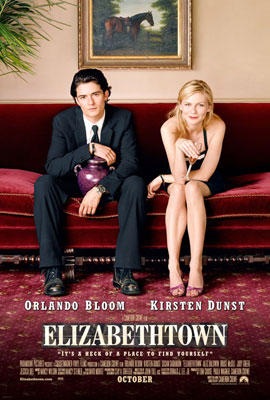
As sad as it is for me to report, the bad buzz surrounding Elizabethtown is by and large a pretty accurate assessment. Up until now I’ve enjoyed all of Cameron Crowe’s movies this misstep is particularly painful after his incredibly solid one-two punch of Almost Famous and Vanilla Sky at the beginning of the decade, two films listed at the top of my favorite films in their respective years. Unfortunately the problems on this film spread far and wide. There are a few instances where Crowe achieves his trademark synthesis of music and film that result in sheer beauty but these are only fleeting moments that temporarily make us forget what a bloated, sloppy, mess of a movie this is.

The brunt of the public’s criticism and initial resistance to the film will probably land on the performances of Orlando Bloom and Kirsten Dunst and this is somewhat justified but not entirely. As with almost all of his performances, Orlando Bloom very much looks the part and for this he does deserve credit, but not enough to disguise that he cannot always act it. His absolutely dismal comic timing made me wonder if the originally cast Ashton Kutcher might have been better fitted for the role. Kirsten Dunst is rather annoying and the attempted accent does not make matters any better but before things delve too deeply into bashing beautiful people, it must be acknowledged that the characters are inherently lacking in themselves. We’ve seen examples of very skilled acting from Bloom and Dunst in films like Black Hawk Down or Eternal Sunshine of the Spotless Mind and The Cat’s Meow so we know that great performances are attainable.

With the characters of Drew Baylor and Claire Colburn, Crowe has scripted his two least interesting and engaging lead characters in his career. In Bloom, Crowe is clearly fishing for a performance on par with John Cusack or Tom Cruise in their heyday but what he does not take into account is that he first has to script a character as personable and sympathetic as Lloyd Dobbler or Jerry Maguire. There are some moments of reprieve in as we are treated to a forceful cameo by Alec Baldwin in the beginning and a great ten-minute segment where Susan Sarandon is given the chance to really act instead of being relegated to hamming it up during trite intervals of supposed comic relief.

There are a few nuggets of nice ideas here that are trapped in a film that will not allow them to meet their potential. Particularly nice is the “last look” voice-over and the conflict of burial versus cremation, but neither are given the chance to grow. The “last look” is especially disappointing in that it has the potential to exist in a heartbreakingly poignant scene but is squandered on the light-weight frivolity here. The movie is not a complete fiasco and only a partial failure. We still get the excellent scenes with Tom Petty’s “Learning to Fly,” Elton John’s “My Father’s Gun” and the climactic “Freebird” that instill hope with Crowe’s next film he will find himself more concise and back on track.