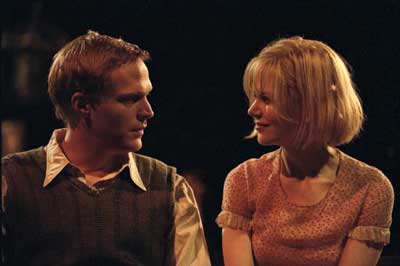
Gender Politics in Dogville and Pierrot Le Fou
Laura Mulvey’s seminal article, “Visual Pleasure and Narrative Cinema,” proposes a number of ideas about spectator identification. The revolutionary theories she presented have been refuted and reinterpreted extensively over the past thirty years. Mulvey’s writing pertains predominantly to mainstream narrative features. However, her text is a very useful one and many of her ideas can be applied to films that skewer the fundamentals of traditional cinema. Even two directors with approaches to film form as radical as Jean-Luc Godard and Lars Von Trier have produced works that are applicable to Mulvey’s teachings. This analysis will compare representations of Mulvey’s arguments in a film by each respective director. The two films being compared are Godard’s
Pierrot le Fou (1965) and
Dogville (2003). The extreme difference in production time period serves as a symbol for how enduring an argument Mulvey makes.
Ostensibly, the films make an odd pair for this type of analysis. The starting point for comparing the two films lies in the similarities of their lead male characters. Both Ferdinand (Jean-Paul Belmondo) in
Pierrot and Tom (Paul Bettany) in
Dogville are pseudo-intellectuals who bury themselves in ideals, analytical dissection and philosophical musings. If forced to label them, one could say Ferdinand is characterized by Sartre’s Existentialism in the sense of denying the universe has any meaning or purpose, therefore the individual must take power into own hands. On the other hand, Tom is Derrida’s Deconstruction, dealing with the ways that meaning is constructed and understood by its readers. Their pursuit of academic enlightenment and intellectualism comes at the cost of not being able to identify with their female counterparts. The male protagonists ignore the emotional desires of their lovers and because of this inability to relate to women, they eventually meet their demise at the hands of the woman (Tom’s case) or the woman’s influence (Ferdinand’s case).
One of Mulvey’s major themes is the casting of the male as active and the female as passive - constructing a male gaze that projects its fantasy on to the female figure. “Presence of woman is an indispensable element of spectacle in normal narrative film, yet her visual presence tends to work against the development of a story line, to freeze the flow of action in moment’s of erotic contemplation” (Mulvey, 840).
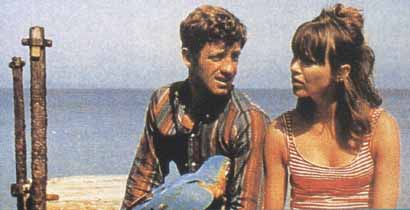
Pierrot le Fou reverses this theory in a variety of ways. The female protagonist, Marianne (Anna Karina), is presented alongside Ferdinand as a co-narrator in a few important sequences. Voice-over narrations provided by the two characters are spliced together to give equal time to the characters as they comment on the plot’s events seen in the sequence following their first murder and subsequent getaway. Marianne’s repeated, “Leave in a hurry,” line is delivered with urgency and expediency. Marianne is also positioned as the sole proponent for propelling the plot forward during the middle section of the film. After making it to the island, Ferdinand is content to sit around and contemplate life but Marianne is more interested in living life, complaining about there being nothing to do. This representation inverts Mulvey’s theory, presenting us with an active female and passive male. It is Marianne’s restlessness that directs the film’s plot back onto the path of gun-running and gangsters. In a scene that can be looked at in comparison with Mulvey’s characterization of women in films existing as showgirls who pause the narrative through song and dance, Marianne appears singing and dancing on the beach while meeting with the gun-runner and orchestrating the plan to set up Ferdinand. Marianne simultaneously progresses the plot and appears as a song-and-dance spectacle.
One of Mulvey’s issues that bears greater importance in
Dogville than in Pierrot is the practice of scopophilia. The term refers to the primary act of looking itself as a “source of pleasure… taking other people as objects, subjecting them to a controlling and curious gaze” (Mulvey, 839).
Dogville is intrinsically linked to this practice by its approach to filmic style. Trier considers the work “a fusion film” (Bjorkman 241). He achieves this product by directly incorporating elements of theatre and literature into a cinematic discourse. He instills the medium of literature through the presence of a third-person narrator voiced by John Hurt. The narrator is omniscient and does not appear as a character in the diegesis, a form that Gérard Genette dubs heterodiegetic. The voice-over is excessive and blatantly invokes the literary format through its constant description of events and internal character reflection.
It is in the incorporation of theater that
Dogville attains its most scopophilic aspect. In an approach that calls upon Thornton Wilder’s
Our Town and the theater of Brecht, Trier shoots the film on a single sound stage with minimal set design. There is the occasional prop (a telephone, a baby carriage, beds, etc.) but chalk outlines delineate houses and walls and characters mime opening and closing non-existent doors. This creates a paradoxically open- and closed-environment for the characters to inhabit. In wide shots, the viewer is given visual access to the private lives of the characters via the absence of physical walls but the characters’ vision is constricted by the diegetic presence of walls. The scene in which this dichotomy is best articulated is Grace’s rape at the hands of Chuck (Stellan Skarsgard). Chuck decides not to inform Grace that the police official is coming and proceeds to blackmail Grace into having sex with him in order to keep him from alerting the police of her whereabouts. In a long shot, the viewer sees the townspeople talking to the police in the middle of the street completely oblivious of Chuck and Grace in the background, despite them being in plain sight for the viewer. To tackle this issue we must address Mulvey’s theory about the three different looks associated with the cinema:
The camera as it records the pro-filmic event, that of the audience as it watches the final product, and that of the characters at each other within the screen illusion. The conventions of narrative film deny the first two and subordinate them to the third, the conscious aim being always to eliminate intrusive camera presence and prevent a distancing awareness on the audience. (Mulvey, 847)
The rape scene in
Dogville perfectly illustrates Mulvey’s distinction between the look of the audience and the look of the characters. However, the scene fundamentally disproves her statement that narrative film subordinates the look of the audience to the look of the characters because in this example the reverse is true. The audience is privileged over the characters in their unobstructed visual access to the town. Ultimately, this look is subordinate to the look of the camera because the camera decides where and when to look during the filming of the event. The viewer cannot choose to suddenly look at the coal mine or the meeting hall at any given moment because the camera dictates what is present on the visual plane. What the audience can do is look anywhere they like within the frame, something the characters cannot do due to physical obstructions.
The importance of characters looking is reprised in the film’s violent conclusion. After initially trying to defend the town, Grace gives the ultimate order for her father’s gangsters to destroy the town and murder all the townspeople. Seated in the backseat of her father’s car, she is asked if they should open the curtains and look out while the town is sacked. Grace responds, “I think we should open them, it’s appropriate.” She observes the town’s demolition in tearful contemplation, occasionally looking away but always returning to the view of the violence. Grace exhibits a certain kind of pleasure in this sequence as she exacts revenge on the townspeople for her constant abuse. She appears particularly vindictive by ordering that the seven children be murdered in front of their mother while she watches. By forcing the mother to witness her children’s death, she is administering and controlling the gaze upon others. In this sequence, Grace asserts herself as the active male, repositioning her role from that of the one looked at by the townspeople. Mulvey says that in mainstream cinema, the man is positioned as in control of the power “by structuring the film around a main controlling figure with whom the spectator can identify” (Mulvey, 842). For almost the entire narrative, Grace has been the subject of a to-be-looked-at-ness by the townspeople. In this final sequence, she overthrows the hierarchy and assumes the position of the main controlling figure. Even though she achieves this authority through the arrival of her father, she is the one issuing the orders and determining the peoples’ fates. Grace even graduates from looking and proves her physical prowess by shooting Tom in the back of the head. The conclusion reaffirms Grace’s autonomy in the narrative, casting her presence as disruptive to the town of Dogville. While the townspeople’s behavior is held responsible for their fates, it is Grace’s role in the narrative that spurs them to behave in the way that they do.
Given her integrality to the plot’s events and her ultimate act of vengeance, Grace can be positioned alongside Marianne as the active female. However, there are also elements of her treatment that adhere to Mulvey’s hypotheses about the male gaze. At one point Liz (Chloë Sevigny) thanks Grace for redirecting the male characters’ looks to her, implying she was tired of being viewed as a sexual object and glad to rid herself of that kind of attention. Once the townspeople begin to blackmail Grace into working overtime, the men also begin to take advantage of her sexually. The narrator informs us that almost all the men were having their turn with her and it was common knowledge throughout the town as the children would ring the town bell to commemorate each occasion. The narrator says the events could not really be considered sexual acts and they were more a form of embarrassment, akin to the way a hillbilly would abuse a cow. Mulvey says that scopophilia gets complicated when forced to consider the act of voyeurism, which “has associations with sadism: pleasure lies in ascertaining guilt… asserting control and subjecting the guilty person through punishment or forgiveness” (Mulvey, 844). Sadism aptly describes the way in which Grace is treated after the townspeople find out she is wanted by the authorities in connection with some bank robberies. Grace mirrors their sadistic behavior in her explosive act of revenge.
Tom is one of the few male characters who does not take advantage of Grace’s body. While he has lustful intentions, he does not force her to have sex with him. Instead he takes advantage of her by approaching her from an academic standpoint disguised as an emotional attachment. Tom attempts to position himself as a figure of influence upon the town by holding moral sermons of enlightenment that he refers to as “illustrations.” He takes pride in being able to analyze the townspeople and gleefully informs Grace about all their shortcomings and character flaws. On the fourth of July he pulls Grace aside and confesses he cannot get a read on her. Grace goads him into saying the feelings mean that he is in love with her and tells him she thinks she is in love with him too. Tom responds to this declaration of love with, “Very interesting. Interesting in a psychological…” before trailing off. This instance distinguishes Grace’s feelings as emotional and Tom’s as scientific. Tom cannot reciprocate Grace’s feelings of intimacy and love, becoming preoccupied with his carnal desires. He also disrespects her intelligence after he lies about stealing money from the medicine closet by telling her “I’m here to do the thinking for you.” Tom not only acts as her brain but also as her voice, representing her at the town meetings which she is rarely allowed to attend.
The pivotal scene for Tom’s character is his decision to call the gangsters. After defending Grace at the meeting, he returns to Grace’s house and expects her to have sex with him. As Tom gets on top of her and begins to thrust, the camera zooms out, suggesting that Grace has finally agreed. After a few seconds Grace contests and the camera zooms back in, teasing the viewer’s presupposed notions about camera movement. The narrator informs the viewer that Tom is angry his feelings of temptation have been found out by God and that Grace had become a threat to his career as a writer. “Tom allows sincerity and ideals in life without getting sentimental about it.” Here Tom chooses academics over emotion and uses his experience with Grace as inspiration for the first chapter of his novel. In this way, Tom enacts a type of his own abuse, using her suffering and torture to jumpstart his literary career. Tom’s mistreatment of Grace can be tied in with Mulvey’s psychoanalytic association of the female figure with the threat of castration:
Ultimately, the meaning of woman is sexual difference, the absence of the penis as visually ascertainable… Thus the woman as icon, displayed for the gaze and enjoyment of men, the active controllers of the look, always threatens to evoke the anxiety it originally signified. (844).
Mulvey says the male unconscious has two options for dealing with this, either demystifying her image through rigorous deconstruction, as Tom does, or by fetishizing - turning her into a simple sex object, as the other men in town do.

In
Pierrot le Fou, Ferdinand puts a similar preference for writing over emotional attachment to people. Douglas Morrey posits that there is a tendency to “associate Marianne with nature, and with a concrete reality, while Ferdinand is associated with language and abstraction (he spends much of the film reading and writing)” (Morey, 27). It is also important to note how much of the film he spends quoting philosophical thinkers or behaving like characters he has seen in a movie: his driving the car into the ocean is a good example of his penchant for cinematic spectacle. Once on the island all he wants to do is write, telling the camera directly that he wants to write about life itself and create something worthwhile. When Marianne brings out a record, he yells “Literature before music!” Marianne later tells the camera that she wanted to buy a record but all their money was spent on books, which she doesn’t care about. Nor does she care about records or money, she just wants to live. Ferdinand also belittles her when she does not catch a reference he makes to the film
Pepé le Moko. Ultimately Marianne double crosses Ferdinand and runs off with the gun-runner she had referred to as her “brother.” It is unclear at what point Marianne decides to double cross Ferdinand. It is possible she was planning it from the beginning and there is also the generic constraint of having a femme fatale in a film noir. But if we look at it sequentially, it appears as a result of his ignoring her needs and desires. She repeatedly tells him she loves him but Ferdinand seems too much in love with himself to reciprocate. A scene early in the film articulates their respective desires. Marianne catches Ferdinand looking at himself in the rear view mirror. When questioned, he says he sees “a man about to drive off a cliff.” Marianne looks at herself in the mirror and says she sees “a woman in love with a man about to drive off a cliff.” Ferdinand admits his self-centeredness and inability to relate to her when he tells the camera, “When Marianne says ‘It’s a nice day,’ what is she thinking? All I have is the appearance of her saying ‘It’s a nice day.”
Both Ferdinand and Tom put their writing before their women and both ultimately pay the price for it. Their demises are slightly different. Tom meets his death at the hands of Grace while Ferdinand kills himself after shooting Marianne. In Ferdinand’s case he gets revenge on Marianne for being double crossed but he loses his mind in the process. Both endings signify their failure to become writers. Even when given the opportunity for repentance, Tom hides behind academics, telling Grace that her experience in
Dogville has been an illustration and that a lot can be learned from it. Following this, Grace gives the order to destroy the town. Just before Grace shoots him, he makes one last bid for literary fame, asking if he can use this as inspiration for his writing. Tom’s clear disillusionment over the situation reiterates his incompetence at personal relations. Conversely, Ferdinand regards Marianne as a distraction that keeps him from obtaining literary enlightenment. However, this proves not to be the case as when he has freed himself from her in the end, he blows himself up with dynamite, saying he is tired anyway. Both
Dogville and
Pierrot le Fou ultimately position their female protagonists as the dominant figures of control over their weaker male counterparts.
RefererencesBjorkman, Stig. Trier on Von Trier. London: Faber and Faber, 2003.
Morrey, Douglas. Jean-Luc Godard. Manchester and New York: Manchester University Press, 2005.
Mulvey, Laura. “Visual Pleasure and Narrative Cinema.” Film Theory and Criticism. Ed.
Leo Braudy and Marshall Cohen. Oxford: Oxford University Press, 2004, 837- 848.